




Overview
Established in 2015, the School of Architecture at CMR University is one of the youngest architecture schools in Karnataka. It is committed to shaping professionals who are socially conscious and ecologically attuned, capable of addressing the complex challenges of the contemporary and future built environment. The School fosters a maker-centred approach to learning, where students reflect deeply on their intentions, choices, and actions through hands-on practice, design critique, and industry exposure. Set against the legacy of the CMR Group in education, the School of Architecture embodies a unique blend of innovation and tradition.
Rooted in the ethos of “Build Less, Build Light, Build Wise,” the School emphasises sustainable, context-aware, and adaptive design. Students are encouraged to think critically, reduce material waste, embrace eco-friendly solutions, and design spaces that evolve with the needs of time and society.
Through vibrant studios, interdisciplinary collaborations, and continuous mentorship by practising architects, learners are immersed in real-world problem-solving. From miniature models to urban-scale proposals, students work at multiple scales, developing design sensitivity and technical rigour while engaging deeply with the city of Bengaluru.
Vision
To nurture ecologically responsible professionals to address the challenges of contemporary human habitat through a maker-centred approach.
Mission
To nurture:
– Collaborative engagement across and between disciplines.
– A critical interplay with technology and its applications.
– Continuous engagement with stakeholders to address the challenges of Bengaluru and its environs.
– An attitude that contributes to the holistic well-being of the community and its ecosystems.
– The ability to comprehend and contribute towards knowledge systems pertaining to the built environment.

We empower to create sustainable spaces at our School of Architecture



Academic Programmes

School of Architecture (SOA)
B. Arch. | Bachelor Of Architecture
-
 75,000 per semester
 -
 Degree
 -
 5 years
 -
 Lakeside Campus
The School of Architecture is approved by the Council of Architecture (CoA), India.
Learning Outcomes
of the School will be able to:
– Synthesise client requirements with personal design ideologies to formulate programme briefs.
– Navigate statutory regulations and guide clients accordingly.
– Conduct detailed site analysis and zoning exercises.
– Design diverse building typologies including residential, commercial, governmental, and institutional structures.
– Integrate structural and service systems seamlessly into their design processes.
– Respond to emerging societal needs with contextual design solutions.
– Appreciate allied disciplines such as urban design, landscape architecture, and visual communication.
– Communicate design ideas effectively using contemporary tools and techniqueGraduates s.
Career Opportunities
Graduates of the B.Arch. programme, are equipped to pursue a wide range of roles in the built environment sector, including architectural design, urban planning, interior and landscape architecture, and construction management. Career paths also extend into sustainability consulting, heritage conservation, BIM specialisation, parametric and computational design, and AR/VR visualisation.
Opportunities exist in both public and private sectors, including roles in PWD, urban development authorities, and the Archaeological Survey of India, as well as entrepreneurship, academia, and international postgraduate study.
Industry Affiliations / Collaborations
The School collaborates with architectural firms, civic bodies, NGOs, and artisans to create immersive learning experiences. Students engage in live projects, internships, and city-based research initiatives, gaining exposure to real-world challenges and solutions.
Career Readiness and Mentorship
From their first year, students engage in career preparedness modules, soft skills training, and continuous mentorship. Through the University’s DCCC (Department of Common Core Curriculum), they also participate in client presentation workshops and project management simulations. Regular exhibitions, public juries, and design expos offer platforms for professional visibility and critical feedback.
A semester-long internship with partner firms is a mandatory part of the curriculum, helping students refine their portfolios and industry readiness. Graduates also receive guidance on entrepreneurship, research pathways, and higher education opportunities in India and abroad.
Student Support Spaces
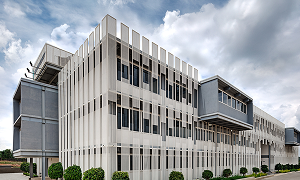
The School of Architecture is housed within the expansive Lakeside Campus on Hennur-Bagalur Road, surrounded by natural landscapes and vibrant academic buildings designed by renowned architects. Students have access to:
– Well-equipped studios, seminar halls, and a dedicated material library.
– A full-fledged Makerspace and Design Thinking Lab with advanced tools.
– Visual arts rooms and workshop spaces for model-making and fabrication.
– A high-performance computer lab with licensed design and rendering software.
The on-campus environment supports independent exploration, cross-disciplinary collaboration, and a deep engagement with the physical act of making.
Campus Environment and Infrastructure
Located within an 80-acre green campus, the School is ideally situated near the international airport and Bengaluru’s innovation corridors. Its infrastructure supports every stage of the architectural learning journey, from theory and design development to construction and display. Key features include:
– A library with a specialised collection of architectural texts and international journals.
– A material museum with a curated display of walling, flooring, acoustic, and ceiling materials.
– A permanent exhibition gallery showcasing exemplary student projects.
– Full-scale construction areas used during annual “FullScale” workshops for prototyping and performance testing.
Placement Highlights
– Industry-aligned curriculum co-designed with practitioners.
– Emphasis on portfolio development and design documentation.
– Semester-long internships with leading firms.
– Informal on-campus recruitment by top studios and developers.
– Annual exhibitions that connect students with potential employers.
– Active alumni network for mentorship and professional networking.
– Entrepreneurship and startup support for independent practice.
Message from the Director
Building Tomorrow’s Architects: Where Ancient Wisdom Meets Digital Innovation
As we stand at the crossroads of unprecedented urban challenges and transformative technological possibilities, I welcome you to the School of Architecture at CMR University, where architectural education is being reimagined for the Anthropocene era. Since our inception in 2015, our journey has been one of purposeful evolution. We have developed a pedagogy that bridges the timeless wisdom of traditional building systems with the transformative potential of digital tools and emerging technologies.
At the heart of our philosophy lies a foundational belief: architecture must serve as a bridge between human aspiration and planetary boundaries. Our motto, Build Less, Build Light, Build Wise, is more than an educational approach, it is our ethical compass in a world increasingly shaped by climate emergencies and rapid urbanisation.
Our MakerSpace is evolving into a dynamic learning ecosystem. Here, students co-create with robotic arms for precision fabrication, experiment with augmented reality for spatial visualisation, develop AI-assisted design tools, and explore 3D printing with sustainable materials such as mycelium composites. These cutting-edge experiences are in constant dialogue with NITARA, our Craft Innovation Lab, where students apprentice with master artisans. They learn from centuries-old terracotta cooling systems, traditional lime mortar formulations, vernacular rainwater harvesting techniques, and indigenous structural principles, grounding their innovation in cultural and ecological wisdom.
One of our most radical pedagogical interventions is the FullScale workshop series, now in its 16th edition. In this unique learning space, students design and build at a 1:1 scale, gaining hands-on experience with material behaviour, construction sequencing, the intricacies of joinery, and the constraints of real-world budgets. This year, we are integrating IoT sensors into these structures to create “living prototypes” that capture data on thermal performance, material ageing, and user interaction.
Bengaluru, one of the world’s fastest-growing urban centres, serves as our extended classroom. Through our CityLab initiatives, students engage with live urban issues such as heat island mitigation, adaptive reuse of industrial heritage, transit-oriented development, and circular economy construction systems. They collaborate with communities, policymakers, and industry leaders to co-create sustainable, scalable solutions.
Our reimagined foundation programme introduces students to the new fundamentals of architectural thinking. It includes modules on material intelligence (from mud to graphene), structural empathy (via physical computing), digital craftsmanship (where parametric design meets artisan techniques), and systems thinking that views architecture as part of wider ecological networks.
To our future students: you’ll find yourself 3D-printing structural nodes in the morning, learning Warli painting’s spatial narratives from tribal artists in the afternoon, and debating blockchain’s role in material passports by evening. We are preparing you not only for today’s studios, but to lead the regenerative practices of tomorrow, where buildings act as material banks, designs are performance-based, and construction itself is a form of restoration.
As we continue to develop our next-generation MakerSpaces and Traditional Knowledge Archives, we remain committed to shaping architects who can speak the language of both algorithms and artisans. We aspire to nurture professionals who can prototype a bamboo joint and programme a construction drone; who understand ancient shading devices as well as nano-coated smart glass; and who are driven to design with cultural continuity and climate resilience in mind.
This is architectural education reimagined, rigorous yet joyful, technologically advanced yet deeply rooted, ambitious yet ethically grounded. I invite you to join us in building this future.
Muralidhar Krishna Reddy
Architect | Industrial Designer
Director, School of Architecture
CMR University